Funafuti Atoll
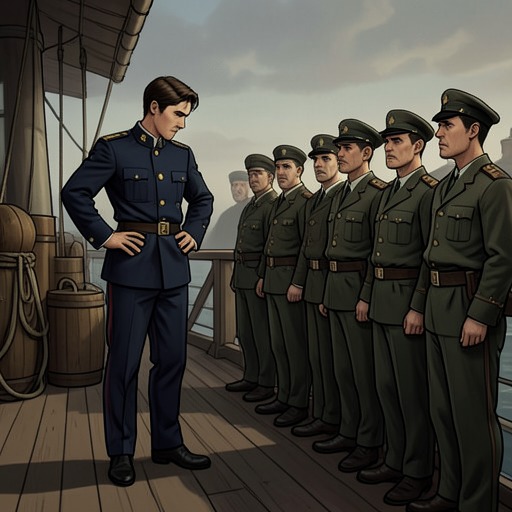
The Caine MutinyFunafuti Atoll is a low-lying island refuge in the Caine’s wartime route through the South Pacific, and a vital support point for the worn destroyer-minesweeper. The ship’s arrival brings a practical reprieve: tied alongside the tender Pluto, it can draw on shore-like services and relieve some of the labor that keeps its small communications staff overburdened. Yet the respite is temporary. The atoll becomes one stop in a grinding cycle of escort assignments rather than a destination or a way out of the war’s routines.
Setting and Arrival
The atoll appears as a necklace of low, green islands across open water. Shortly after sunrise, the Caine steams through a gap in the reef’s long white line of breakers, moving slowly into the sheltered water. Half an hour later, it is secured to the port side of the destroyer tender Pluto, outboard of two other ships.
The arrangement turns the Caine from a self-contained working vessel into a ship being sustained by a larger one. Lines carrying steam, water, and electrical power are run across to it, and its fires are allowed to die. The tender lies at anchor fifteen hundred yards from the beach of Funafuti Island, placing the Caine close to a substantial base of support without taking it out of the fleet’s demands.
A Base for Communication and Relief
Willie Keith is among the first to cross the gangplank. The tender’s communications office decodes and mimeographs fleet messages, a service that saves him days of work. On the Caine, the stream of messages—including AlPacs, AlComs, AlFleets, GenPacs, PacFleets, AlNavs, NavGens, SoPacGens, and CentPacGens—forms a substantial part of the communicators’ burden. Funafuti therefore offers more than a secure berth: its tender can take over a recurring task that otherwise consumes the ship’s time and labor.
The contrast extends beyond communications. The Pluto is a floating complex of workshops and services, including a machine shop, barbershop, carpenter shop, laundry, kitchen, and bakery. Its orderly, clean-painted spaces and plentiful provisions differ sharply from life aboard the Caine. The visit briefly exposes Willie to a more comfortable version of naval life, but the tender’s support does not change the Caine’s underlying assignment or condition.
Place in the Caine’s Operational Circuit
After reaching Funafuti, the Caine falls under the Seventh Fleet, whose need for escorts sends it through repeated transfers between bases and task groups. From Nouméa, it is detached to Guadalcanal with landing craft; after a week at anchor there, it returns to Nouméa, then makes further trips between Nouméa, New Guinea, Guadalcanal, and Funafuti. The account’s repeated movements give the atoll a distinctive place in the ship’s itinerary: the Caine returns for a brief glimpse of the Pluto before being sent westward again to Guadalcanal.
These assignments are escort work, not a single continuous battle. The route makes visible how the Caine is used within the larger naval effort: an obsolete destroyer-minesweeper, attached to no permanent command, can be redirected wherever a fleet authority needs escorts. Funafuti’s importance lies partly in this system of support and movement. It offers a place to replenish and reduce routine workload, while the ship remains subject to distant operational demands.
Narrative Significance and Historical Qualification
The atoll’s brief calm stands against the Caine’s prolonged experience of fatigue, repetitive watches, and paperwork. In the larger course of the ship’s service, however, even a useful anchorage cannot interrupt the cycle for long. Days and weeks blur into recurring duties, and a visit to the Pluto becomes a short reprieve remembered within a much longer circuit of escort voyages.
The novel identifies itself as fiction set in the historical period of World War II and cautions that the times and places of particular operations, ship missions, and naval procedures have been altered. It also states that the Caine and the events aboard it are imaginary. Funafuti’s depiction should therefore be read as part of the novel’s constructed wartime setting, not as a precise record of a particular historical operation.